

Every state in the U.S. has experienced a tornado (a powerful, rotating column of air that touches the ground) at least once. Tornadoes can cause a lot of damage. How do tornadoes form? To answer this question, we need to look at thunderstorms. Tornadoes form inside thunderstorms.
Thunderstorms form when warm, moist air near the ground rises into the atmosphere. The rising air currents are called updrafts. The warm air cools as it rises. Water in the air that is in a gas state changes to a liquid. A large cloud forms. Eventually rain starts to fall towards the ground. As the rain falls, a column of cool air also moves down toward the ground. Air currents that move toward the ground are called downdrafts.
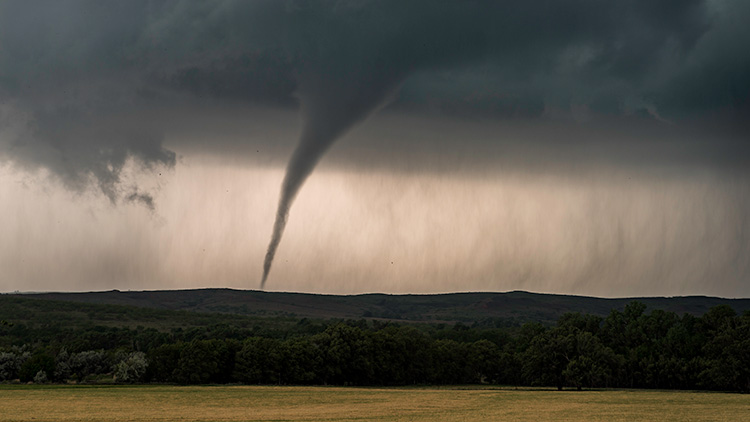
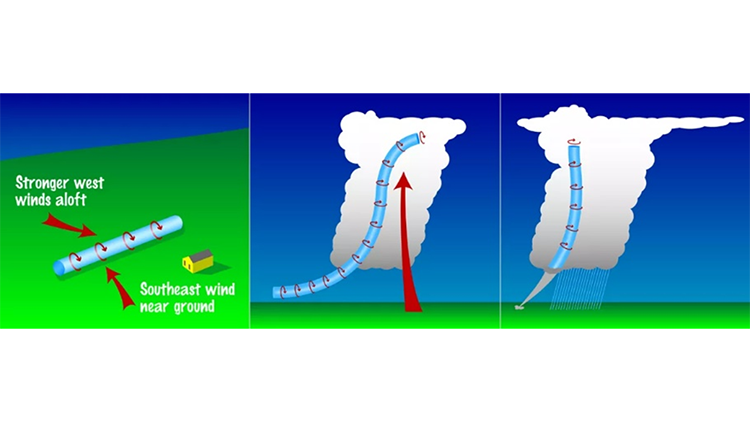
Some thunderstorms are called supercells. In a supercell, the updrafts start to spin. This happens when the wind is blowing in one direction near the ground and in another direction higher up. In a different area of the supercell, the cooler air that has moved down near the ground also starts to spin. This spinning column of air can be pulled up by the larger updrafts that are also spinning. A funnel cloud (a rotating column of condensed water droplets that extends down from the base of a thunderstorm) can form. When a funnel touches the ground, it becomes a tornado.
Most tornadoes last for about 10 minutes. Some tornadoes end when the thunderstorm weakens. Running into hills can also break up a tornado.
What Can You Do? What happens in a supercell?
Photo Credit: (t)NOAA/JPL-Caltech, (b)Willard Sharp/500px