

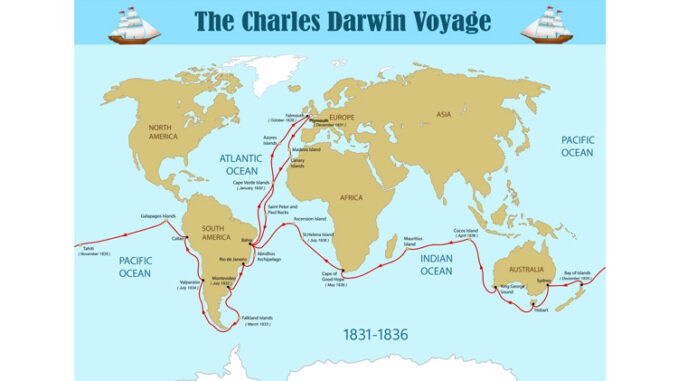
Imagine spending almost five years sailing around the world. Living on a boat the whole time! That is what Charles Darwin did from 1831–1836. He was the naturalist (a person who studies plants and animals by observing them) on board the HMS Beagle. December 27 is the 174th anniversary of the HMS Beagle setting sail from England on its historic trip. The ship made many stops along the way. Darwin explored each area. He filled notebooks with observations and drawings of plants and animals.
One of the places that Darwin found most interesting was the Galápagos Islands. Darwin noticed that each island had a slightly different environment. Some were dry, like a desert. Some were wetter. The tortoises (a turtle that lives on land) on each island were also slightly different. Their shells had different shapes. The tortoises could reach different heights of leaves to eat.
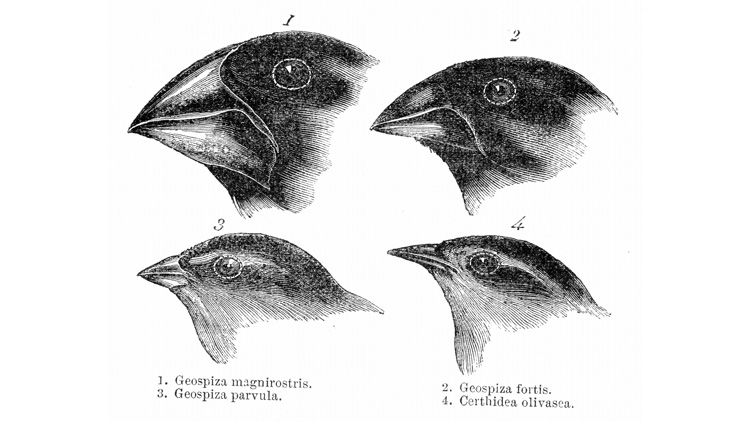
Darwin also noticed that the finches (group of small songbirds) were different depending on the island. They had beaks of different sizes and shapes. Darwin observed that the finches ate different food. The food they ate was based on the size and shape of their beaks. He wondered about the different environments on each island. He asked questions. He wanted to know if the environments affected shell shape in the tortoises. Did the environment affect beak shape in the finches?
When Darwin returned home from the voyage, he spent years reviewing his notes, working on his theory. In 1859, he published his book explaining how species (a group of living things with similar traits that are able to reproduce) change over time. He explained how the environment affected how species change over time. Today, the Galápagos Islands are a living laboratory for scientists studying how species change over time.
What Do You Think? What plants and animals can you observe in your area?
Photo Credit: (t)Zaporizhzhia vector/Shutterstock, (b)Photos.com/Getty Images