


On January 3, 2026, many places in the northern hemisphere were cold and covered in snow. That makes sense. It’s winter! But, would you be surprised to know that on that day, Earth was closest to the Sun in its orbit (Earth’s path around the Sun). How is that possible?
First, we have to look at the shape of Earth’s orbit. It’s elliptical, like the shape of an egg. That means that at one point in the orbit, Earth is closest to the Sun. At another point, it is farthest from the Sun.
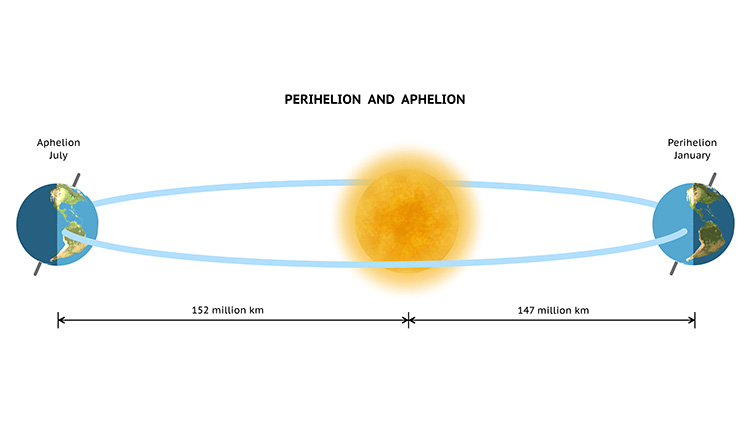
You might think that temperatures would be warmer when Earth is closer to the Sun. But temperatures have more to do with the tilt of Earth’s axis (an imaginary line that goes through the middle of Earth from top to bottom).
Earth’s seasons, spring, summer, fall, and winter, happen because Earth is tilted on its axis. As Earth orbits the Sun, different parts of Earth are tilted toward or away from the Sun throughout the year.
For example, in the northern hemisphere during winter, the northern hemisphere is tilted away from the Sun. Days are shorter and there is less sunlight. So, temperatures decrease. It is summer in the southern hemisphere during this time.
During the summer, the northern hemisphere is tilted toward the Sun. Days are longer and there is more sunlight. So, temperatures increase. Even though Earth is farthest from the Sun in July. It is winter in the southern hemisphere during this time.
What Can You Do? What is the weather like in January in your area? Why?
Photo Credit: (t)Dainis Derics/iStock/Getty Images, (b)J. Marini/Shutterstock